Monday, July 25, 2011

Remembering Triangle Classifications

What do we know?
Three sides 
Three angles 
Interior Angles have a sum of 180*
Now there is more:
Isosceles - has two congruent sides called legs and a third side called the base.  The vertex angle is the angle included by the legs.  The other two angles are called base angles.  The base angles are congruent. 
Equilateral - a special isosceles triangle in which all three sides are congruent.  Equilateral triangles are also equiangular, which means all three angles are congruent.  The measure of each angle is 60 degrees.

Scalene - a triangle with no congruent sides or angles.
Right - a triangle with one 90* angle
Obtuse - a triangle with one obtuse angle measuring more than 90*
Acute - a triangle with three acute angles that each measure less than 90*

Most of these terms are rather easy to remember.  It's easy to remember that a right triangle has a right angle.  An equilateral triangle has equal sides and angles: it's equal all over.  Scalene is kind of a weird word, but so are the triangles classified as scalene: these triangles have no congruent anything.  Obtuse and Acute are opposites, and I remember that acute is the smaller of the two by thinking to myself "Oh, what a-cute little angle!"  Obtuse isn't cute.

Disecting Compound Interest

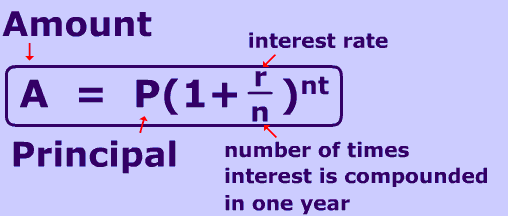
I'm not good at memorizing formulas, so it's easier for me to remember how to calculate compound interest if I break it down and understand it.  Here is the formula:
 So let's break this down:
 A is the amount.  This is the total amount after interest is applied.  This is typically the solution to a simple compound interest problem.
P is the principal.  This is the initial investment amount.
R is the rate of interest.  This rate reflects how many dollars per $100 will be earned.  2.5% means you'll earn $2.50 per $100 invested.
n is the number of times the interest compounds each year.  An annual compound is once, a semi annual compound would be twice, and a quarterly compound would compound 4 times a year.
t is the number of years the interest will be growing the principal.

So what's happening?  For  rate of interest is multiplied by the principal for the first year and then applied to the total amount.  For every next year the total amount will be multiplied by the interest rate, meaning a greater amount of earning occur each year due to the higher total investment.  This is what that looks like:
 Earnings grow exponentially because each year (or instance of compound) the earned interest is applied to the total.  The curve of exponential growth is it's steepest after years of compounded interest.  This is why so many retirement commercials are targeting young adults, urging them to start an investment plan early to take advantage of the most steep areas of the growth curve.

Sunday, July 24, 2011

Factorial Fun

Every once in a while I'll see something in my math homework that forces my brain into a traffic jam.  I know I've seen that exclamation point used in math before, but I haven't the slightest idea anymore what it means.  Time to brush up on Factorials:

In mathematics, the factorial of a non-negative integer n, denoted by n!, is the product of all positive integers less than or equal to n. For example,
5 ! = 5  \times  4  \times  3  \times  2  \times  1 = 120  \
Oh yeah!  I recognize that descending series of multiplication problems.  I think I had a calculator that saved me some longhand work in high school when we went over factorials.  The calculator helped me rip through my homework, but didn't help me remember the content of the lesson.

Another important detail to remember about Factorials:  0! = 1.  This is often described as one of these weird things you just have to accept.  I tried to read up on and understand completely why, but I'm now comfortable sticking to the old stand-bye answer of:  it just does.  For a more thorough explanation follow this link!


When I teach factorials and permutations I'll use problems like this one about license plates:


License plates for cars have to be unique. If a license plate contains 6 characters consisting of 2 letters followed by 4 digits example:  QW2354

  • how many different license are possible?


    [26] x [26] x [10] x [10] x [10] x [10] = 6,760,000 
  • how many different license are possible if letters were allowed to repeated but numbers are not allowed to be repeated?


    [26] + [26] + [10] + [9] + [8] + [7] = 3,407,040

Humor Benefits Classroom Environment

One characteristic of effective teaching is maintaining an appropriate classroom environment.  There is no one kind of classroom environment that is correct.  The most appropriate classroom environment is crafted to meet the needs and interest of the students, the school, and the teacher.  Humor is both a part of the student-teacher relationship and a part of the classroom environment.  Humor is predicated on a safe comfortable atmosphere where it's acceptable to laugh and err.  Trial and error learning cannot exist if students don't feel safe enough to try.  I love humor because if used correctly it breeds positivity.  Even though teachers and students may have generational gaps complicating communication, humor is timeless and helps bridge that gap.

This dated video highlights a difference in communication between generations and also shows how humor and positivity can effect student efficacy.  Bad Grimes reminds me of some older control obsessed teachers I've witnessed.  He's intense and fixated on maintaining a stern and silent classroom environment.  Bad Grimes makes poor decisions when discussing students' scores on a recent test and certainly does not encourage students to succeed by highlighting their failures as students.  Good Grimes recognizes that if students are struggling that it's possibly his failure as an instructor to properly communicate or teach.  Good Grimes is encouraging and reestablishes student efficacy by helping them succeed and experience success. 

From the date of this video, it's no news that humor is effective in the classroom.  I tried to recall teachers from my past that employed copious humor in their teaching style, but I think it's hard to recognize a teacher with a sense of humor as a child.  I imagine that the teachers with humor were the ones that sent to the principals office less often.  I'm thankful that my teachers had a sense of humor, and I look forward to having an awkward and dated sense of humor that is hilariously out of touch with my keen groovy rad hip cool (is cool still cool?) students.

Saturday, July 23, 2011

Cylinder Surface Area and Volume: Keeping Formulas Straight

Memorizing formulas has always been confusing business for me.  If all I know about an operation or problem is the formula than it becomes nearly impossible to remember.  What I'm getting at is this: once I understand what the formula is doing to the numbers and why, I won't forget it.  This isn't just the way my brain works, but this describes how I retain information most effectively.  I remember something best if I dissect it and see how it works.  Once I understand how it works, it's easily woven into memory.

Sometimes while calculating the surface area and volume of a cylinder I found myself unsure which formula I should use...

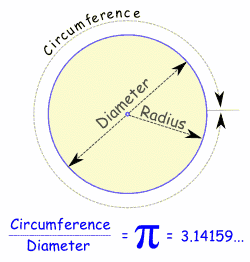
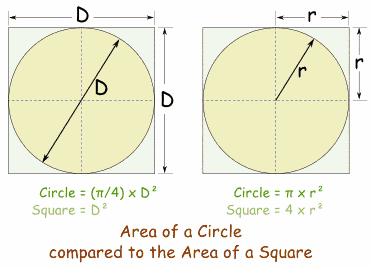
The two formulas I would get confused and accidentally interchange were the formulas for circumference and area of a circle.


To calculate the circumference we are multiplying the diameter by that special irrational number describes the relationship between the circumference of a circle and the diameter.


Another way to remember which formula to use it to examine the units of the answer.  If the answer needed is area than it must use the formula that produces an answer in two dimensions or squared units.  Similarly, if the answer is a volume you must use the formula that produces an answer in 3 dimensions, or cubed units.  Keeping the units accurate throughout the process of a multi step solution can save the solver tons of headache and confusion.

Friday, June 17, 2011

Importance of Directions


The importance of reading the directions thoroughly!

Occasionally while completing my Math homework for frequency distribution I found myself puzzled when the computer wouldn’t accept my answers as correct.  I’m sure I counted all those darned numbers, didn’t I?  I knew I wasn’t wrong: my answer was perfect.  I overlooked details in the instructions, and perfectly answered the wrong question. It can get pretty frustrating recounting, recalculating, and regretting not simply reading the directions properly.  No wonder it wouldn’t accept my answer!

Being an effective teacher means empowering students with the knowledge and skills to be effective learners and students.  Reading directions completely and thoroughly is an important habit/tool for all students.  Here is a website with some activities teachers can use to emphasized the importance of directions:

http://www.educationworld.com/a_lesson/lesson/lesson275.shtml

Since this is a blog, here is a personal touch: a quote about statistics....

“There are lies.  There are damn lies.  And then, there are statistics...”